
The way households consume live television has fundamentally shifted. For decades, access to live sporting events, international news, and premium entertainment required locking into expensive multi-year contracts with cable monopolies or installing fragile satellite dishes on the roof. Today, modern IPTV services (Internet Protocol Television) have dismantled that legacy model, routing high-definition television broadcasts directly through your home broadband connection with unprecedented flexibility, lower costs, and global variety.
However, navigating the landscape of IPTV services can be daunting for cord-cutters. The market ranges from high-cost domestic broadcaster packages to independent enterprise networks, as well as thousands of unstable reseller panels that collapse during weekend live sports. In this comprehensive 2026 guide, we break down how IPTV services actually operate under the hood, analyze the technical benchmarks that separate resilient networks from fragile resellers, and provide actionable criteria to choose the best IPTV service for your home.
⚡ What Exactly Is an IPTV Service?
An IPTV service delivers live television channels and on-demand video using the Internet Protocol suite rather than conventional terrestrial radio frequency, satellite signal, or closed coaxial cable television formats. Content is streamed as continuous data packets, allowing instantaneous channel switching, global accessibility, and interactive features like Electronic Program Guides (EPG).
How Modern IPTV Services Actually Deliver Video Streams
Unlike traditional television, where all channels are broadcast simultaneously over a physical cable line into your tuner, IPTV services utilize a pull-based network architecture. When you switch to a channel on your TV screen, your media player sends a real-time request to the server, which unicasts that specific digital video feed to your device.
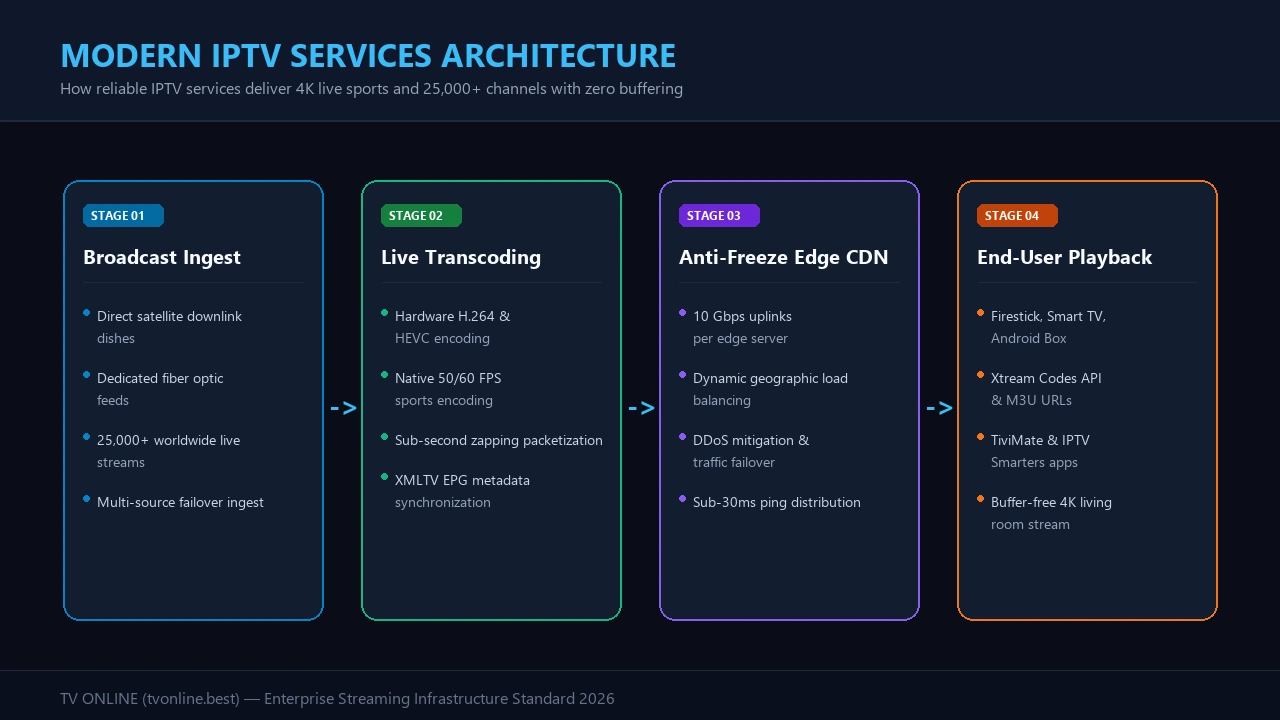
High-performance IPTV services operate across four coordinated technical stages:
- Broadcast Signal Ingest: Satellite downlink dishes and direct fiber links capture broadcast feeds from regional and international television networks across North America, Europe, the UK, and Latin America.
- Real-Time Hardware Transcoding: High-density rackmount encoders compress raw broadcast video into standardized H.264 and HEVC (H.265) streams, balancing high bitrates with efficient bandwidth usage to deliver sharp 1080p and 4K UHD resolutions at true 50 and 60 frames per second (FPS).
- Distributed Edge CDN Distribution: Video streams are pushed to geographically distributed edge servers operating with 10 Gbps network uplinks. Rather than funneling all global subscribers through a single bottlenecked origin server, top-tier IPTV services route traffic dynamically to the node nearest the viewer.
- Client-Side Application Playback: Third-party media players such as TiviMate, IPTV Smarters Pro, or IBO Player receive the HLS (HTTP Live Streaming) or MPEG-TS packets, decoding them smoothly on streaming hardware like the Amazon Fire TV Stick, Smart TVs, or Android TV boxes.
The 3 Core Categories of IPTV Services in 2026
Understanding the different categories of IPTV services allows cord-cutters to align their budget with their viewing expectations:
Corporate Broadcaster OTT
Services like YouTube TV, Sling TV, and Hulu + Live TV. They offer licensed domestic channels with cloud DVR, but suffer from high subscription fees ($75–$90/month), aggressive regional blackouts, and limited international channel selections.
Tier-1 Managed IPTV Networks
Independent enterprise networks like TV Online that own direct encoder racks and CDN nodes. They deliver 25,000+ worldwide channels, 4K sports at 60 FPS, full 7-day EPGs, and single-device pricing starting from under $12/month.
Wholesale Reseller Panels
Cloned storefronts reselling credits on shared, overcrowded backend servers. Characterized by severe buffering during peak weekend sports, missing EPG data, and lack of technical support. Learn how to identify them in our guide to IPTV providers.
Essential Technical Features to Demand from Reliable IPTV Services
Before choosing between competing IPTV services, verify that the provider incorporates these five foundational technical pillars:
1. Anti-Freeze Load-Balanced Server Architecture
Video buffering occurs when origin server bandwidth becomes saturated. Premier IPTV services deploy automated load-balancing algorithms that distribute viewer requests across redundant server clusters. If a specific edge node experiences latency or packet loss, the stream fails over to an alternate uplink in milliseconds, ensuring completely uninterrupted playback. If you experience freezing with an existing provider, consult our guide on how to stop IPTV buffering.
2. True 60 FPS Sports Streams vs. Compressed 30 FPS Feeds
Motion smoothness is paramount when streaming fast-moving sports such as soccer, NFL football, hockey, Formula 1, and basketball. Cheap IPTV services cut costs by transcoding feeds at 25 or 30 FPS, causing moving balls and panning cameras to jitter noticeably. Dependable sports IPTV services broadcast live feeds at true 50 to 60 frames per second with high bitrates.
3. Automated 7-Day Electronic Program Guide (EPG)
A modern TV experience depends on an organized, accurate TV guide. Reliable IPTV services provide continuous XMLTV EPG data pipelines that display current show titles, air times, episode descriptions, and upcoming programming schedules automatically synced to your local time zone.
4. Standard Xtream Codes API & M3U Playlist Protocols
Avoid services that force you to use locked-down, ad-supported proprietary applications. The best IPTV services provide standardized Xtream Codes API credentials (Server URL, Username, and Password) alongside M3U playlist URLs, allowing you to configure the stream in elite third-party players like TiviMate or IPTV Smarters Pro.
5. Expansive VOD Library with Regular Updates
Beyond live television, leading IPTV services maintain on-demand cinema catalogs containing 60,000+ movies and complete multi-season series with multiple audio tracks and multilingual subtitles.
IPTV Services vs. Traditional Cable TV: Comprehensive 2026 Comparison
| Feature / Benchmark | Traditional Cable & Satellite | Corporate Broadcaster OTT | TV Online IPTV Services |
|---|---|---|---|
| Average Monthly Cost | $95.00 – $140.00 / mo | $75.00 – $89.99 / mo | From $5.41 / mo |
| Live Channel Count | 150 – 300 Local Feeds | 85 – 120 Domestic | 25,000+ Worldwide Channels |
| 4K Sports at 60 FPS | Extra Tier / Rare Feeds | Limited 4K Add-on ($10/mo) | Included in All Plans |
| Contract Requirements | 12 to 24-Month Lock-in | Month-to-month | None (Pay-as-you-go) |
| Hardware Set-Top Rental | $10 – $15/mo per television | $0 (Bring your own device) | $0 (Bring your own device) |
| EPG Guide & Catch-Up | Included | Included (Cloud DVR) | 7-Day XMLTV Guide + Catch-up |
| Multi-Screen Freedom | Tied to home coaxial cable | Home network restricted | Portable across all devices |
5 Critical Red Flags When Evaluating IPTV Services
Protect your money and avoid frustrating streaming experiences by watching out for these warning signs:
- The "Lifetime Subscription" Scam: Any provider offering lifetime access for a single flat fee ($50 or $100) is almost guaranteed to shut down within 3 to 6 months. High-speed video streaming requires ongoing CDN server hosting and bandwidth costs; lifetime deals are economically unsustainable exit scams.
- Exaggerated 80,000+ Channel Claims: Legitimate global broadcasts number between 20,000 and 25,000 active channels. Services advertising 80,000+ channels are running unmaintained scrapers loaded with dead links and offline video loops.
- Refusal to Offer Short-Term Subscription Plans: Reputable IPTV services let customers test their network with a 1-month or 3-month option before committing to annual plans. Always review transparent terms on our subscription pricing page.
- Anonymous Sellers Without Secure Portals: Be cautious of operations operating exclusively through private Telegram groups or anonymous web forms that lack direct human customer support.
- No Dedicated WhatsApp or Ticket Support: If a stream buffers during a live tournament and the provider lacks real-time assistance, you are left stranded with no technical recourse.
Best Hardware and Applications for IPTV Services
To enjoy pristine 4K video playback with zero frame stutter, pair your subscription with proven hardware and player apps:
Recommended Hardware Devices
- Amazon Fire TV Stick 4K Max: The most popular and cost-effective device for streaming IPTV services. Its quad-core processor and Wi-Fi 6 support ensure seamless 4K video decoding. Learn the full configuration process in our Firestick IPTV setup guide.
- Nvidia Shield TV Pro / Apple TV 4K: Enterprise-grade streaming boxes offering the highest processing horsepower, gigabit Ethernet ports, and AI video upscaling.
- Smart TVs (Samsung Tizen & LG webOS): Excellent all-in-one living room solutions that allow direct player installation without extra HDMI sticks.
Top Media Player Applications
- TiviMate IPTV Player (Android / Firestick): Widely recognized as the gold standard player, featuring a broadcast-style EPG, sub-second zapping, and 4-channel multi-view.
- IPTV Smarters Pro (Multi-Platform): Highly versatile, user-friendly player available across Android, iOS, Windows, Mac, and Samsung/LG smart TVs.
- IBO Player: Lightweight, ultra-fast application optimized for smart televisions that support direct installation from the LG Content Store and Samsung App Store. Compare all options in our review of the best IPTV players.
How to Test and Benchmark an IPTV Service Before You Buy
Before committing to a long-term plan, follow this 4-step stress-test protocol:
- Step 1: Start with a Flexible Plan: Choose a 1-month or 3-month plan to verify server quality on your home network.
- Step 2: Stream During Peak Weekend Match Times: Almost every provider functions smoothly on a Tuesday morning. The real test is Saturday afternoon when millions of viewers tune into Premier League or NFL games.
- Step 3: Inspect Player Codec and Frame Rate: Open stream info in TiviMate or VLC and verify true 50 or 60 FPS rather than a compressed 25 FPS feed.
- Step 4: Check Network Latency and Buffer Size: Ensure your home internet delivers at least 30 Mbps with low jitter. Review our benchmark guide on internet speed needed for IPTV.
Frequently Asked Questions About IPTV Services
What is the difference between IPTV services and regular streaming apps?
Standard streaming services like Netflix, Disney+, and HBO Max deliver pre-recorded video-on-demand files over public content servers. IPTV services provide live linear broadcast television channels (such as sports, news, and entertainment networks) streamed in real time with electronic program guides, mimicking traditional cable television over broadband internet.
How much internet speed is required to stream IPTV services smoothly?
For standard definition and 720p HD streaming, a stable download speed of 10 to 15 Mbps is sufficient. For uninterrupted Full HD 1080p and 4K Ultra HD live sports at 60 FPS, we recommend a reliable internet connection of at least 25 to 30 Mbps connected over 5 GHz Wi-Fi or wired Ethernet.
Can I use one IPTV service across multiple televisions in my home?
Standard subscription plans typically permit one active stream at a time. If you want to watch live television simultaneously on multiple screens across different rooms, select an IPTV multi connection package that supports concurrent devices.
Do I need a VPN when using IPTV services?
While top-tier IPTV services operate without requiring a VPN, using one can prevent aggressive internet service provider (ISP) throttling during major live sporting events and protect your browsing privacy.
How do I choose between different IPTV services in 2026?
Look for direct Tier-1 infrastructure providers with anti-freeze load balancing, true 60 FPS sports streams, automated 7-day EPG guides, and responsive human customer support directly on WhatsApp. Read our comprehensive IPTV streaming services review for side-by-side performance benchmarks.
Upgrade to TV Online and enjoy 25,000+ live television channels, 4K sports at 60 FPS, 60,000+ VOD titles, and rapid 24/7 human customer support with zero lock-in contracts.
Explore TV Online Subscription Plans →