
Search for television streaming subscriptions today, and virtually every provider claims to offer an “iptv premium” service. Websites are plastered with promises of 30,000 live channels, “revolutionary anti-freeze technology,” and pristine 4K video for the price of a cup of coffee. Yet, ask anyone who has purchased one of these suspiciously inexpensive subscriptions, and the reality is strikingly different: feeds stutter during the final minutes of a championship football match, customer support vanishes the moment your payment clears, and channels labeled “4K UHD” display pixelated 720p video at a jerky 25 frames per second. The word “premium” has become one of the most abused marketing labels in modern cord-cutting. However, genuine enterprise-grade IPTV infrastructure does exist—delivering broadcast-grade reliability that rivals or outperforms traditional satellite and cable television. In this comprehensive guide, we strip away the marketing fluff to explain what actually powers a true premium streaming service, how to audit stream bitrates and server health, and how to avoid the hidden traps of cheap reseller panels.
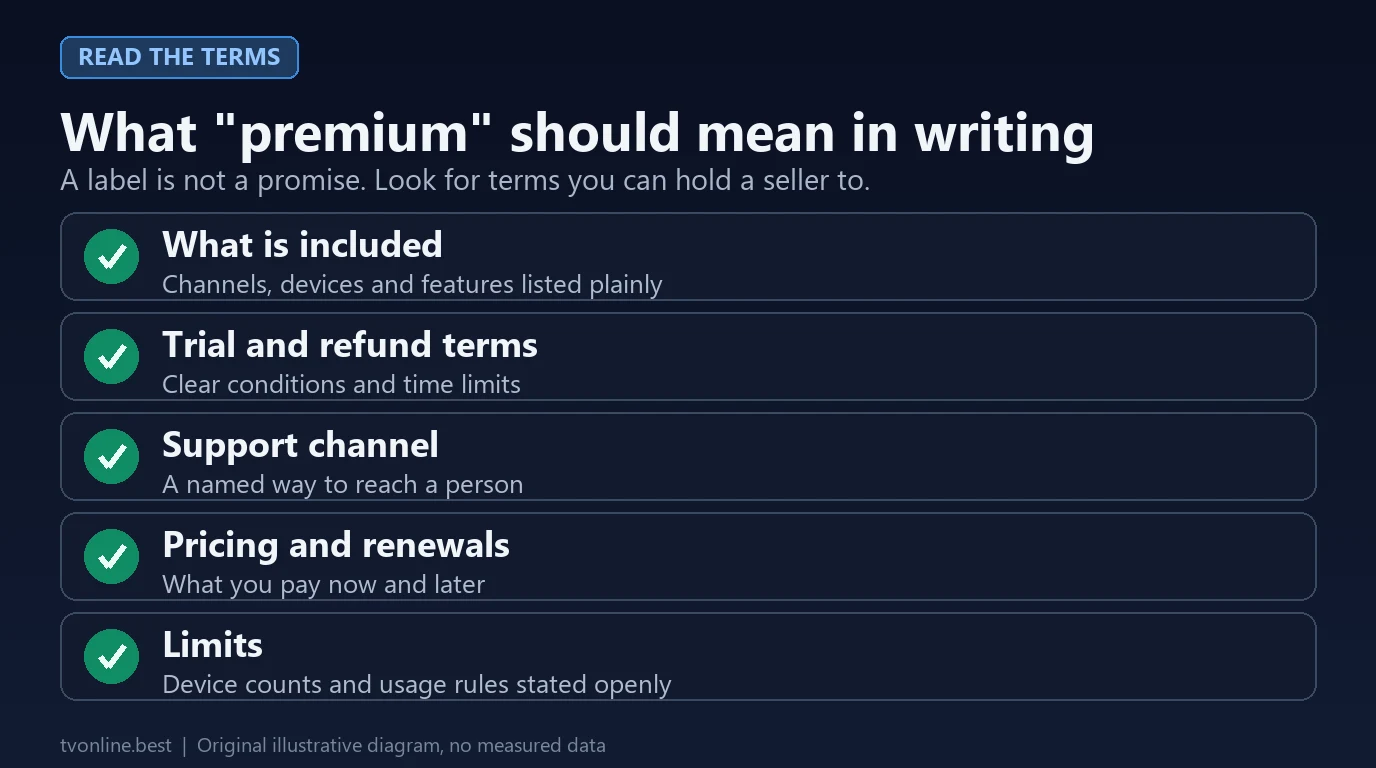
Editorial Methodology: We evaluate premium IPTV tiering by examining publicly documented technical features, supported video codecs, and published customer service channels. Confirm plan terms and trial availability before making multi-month commitments.
⚡ Core Infrastructure Truth: You Get What You Pay For
Dedicated server bandwidth and 60 FPS transcoders require massive operational capital. When prime-time sports kick off, those networks fail inevitably. True premium IPTV utilizes private CDN edge clusters to eliminate buffering during peak viewership.
The “Premium” Label Dilemma: Marketing Gimmick vs. Real Infrastructure
To understand why stream quality varies so wildly across the market, you must understand how video signals travel from the original broadcast studio to your television screen:
The Cheap Reseller Panel
Sellers purchase bulk lines from a shared upstream server. Thousands of concurrent viewers share a single unmanaged network interface. Peak-time sports events bottleneck bandwidth immediately, causing packet drops, endless loading wheels, and stream blackouts.
Dedicated CDN Architecture
Authentic premium providers distribute live feeds across geographically balanced Content Delivery Network (CDN) edge nodes. If 10,000 local viewers tune into the same football match, the stream is cached and delivered by local data centers, keeping latency under 30ms.
The 5 Pillars of a Legitimate Premium IPTV Service
Before committing your hard-earned money to an IPTV service, verify that the provider fulfills these five core infrastructure benchmarks:
- 1. Dedicated CDN Edge Servers & Anycast Routing: Intelligent Anycast DNS routes your streaming device to the geographically closest server node. If an international fiber carrier suffers an outage, traffic automatically fails over to a secondary node without dropping your live stream.
- 2. True 4K & Uncapped 60 FPS Bitrates (HEVC / H.265): Genuine 4K requires modern HEVC encoding and sustained bitrates between 20 and 30 Mbps. Live sports demand 50 or 60 frames per second; watching fast action at 25 fps creates motion blur and eye strain. Explore our dedicated breakdown of IPTV for sports streaming for complete frame rate optimization.
- 3. Smart Anti-Freeze & Forward Error Correction (FEC): While cheap providers rely on standard TCP connections that buffer whenever a packet drops, premium networks utilize optimized UDP and low-latency HLS protocols backed by parity recovery data, allowing the video player to reconstruct missing frames on the fly without pausing.
- 4. Automated 7-Day EPG & Multi-Day Server Catch-Up: Navigating thousands of channels without an accurate TV schedule is frustrating. Premium providers maintain daily-updated XMLTV feeds. To resolve guide formatting issues, check our complete guide on the IPTV schedule.
- 5. Multi-Device Compatibility & Multi-Screen Connections: True premium services supply flexible M3U Plus playlists and Xtream Codes API credentials compatible with top-tier players like TiviMate, UHF IPTV, and IPTVX, along with multi-connection plans for concurrent household streaming.
How to Spot Fake “Premium” IPTV Services (Red Flags Matrix)
| Marketing Claim | What the Provider Tells You | What Is Actually Happening |
|---|---|---|
| “50,000+ Live Channels!” | “Unmatched global library.” | Many of the streams may be broken links, duplicate feeds, or 240p foreign channels used solely to inflate marketing statistics. |
| “Lifetime Access for $35!” | “Pay once and stream forever.” | Services priced this way often struggle to cover recurring server costs. High-bandwidth streaming infrastructure requires recurring server costs; lifetime passes are often unsustainable. |
| “No Free Trials Available” | “Exclusive VIP server access.” | The operator knows the service freezes during peak evening hours and wants to lock in your money before you witness the stream degradation. |
| “Crypto Only Payments” | “Maximum user privacy.” | Providers refusing credit cards or standard processors prevent you from issuing a bank dispute or chargeback when their streams go dark. |
Comparing Your Options
For our complete ranking of top-tier services, read our comprehensive review of the best IP TV providers on the market.
The Real Cost of Premium IPTV: What Should You Expect to Pay?
Dedicated fiber bandwidth, colocation hosting in Tier-3 data centers, commercial satellite capture cards, and 24/7 monitoring engineers are real overhead costs.
- 1-Month Pass: $12.00 – $18.00 / month (Best for trial runs and testing peak-hour performance).
- 3-Month Pass: $30.00 – $40.00 (~$10 – $13 / month).
- 6-Month Pass: $50.00 – $65.00 (~$8 – $11 / month).
- 12-Month Annual Pass: $75.00 – $95.00 / year (Best overall value, averaging ~$6.50 – $8.00 / month).
Hardware and Player Pairings for Maximum Performance
Even the most pristine 4K stream will stutter if your streaming stick lacks hardware decoding power. To get the best results:
- Use Hardwired Ethernet: Local Wi-Fi interference is a common cause of perceived “buffering” issues. Connect an Ethernet cable directly to your streaming box or TV.
- Select Native Applications: Use dedicated media players like TiviMate on Android TV or UHF IPTV on Apple TV 4K. For a complete software breakdown, see our guide to the best IPTV player.
- Troubleshoot Network Bottlenecks: If you experience intermittent pauses over high-speed internet, follow our step-by-step diagnostic on how to fix IPTV buffering and freezing.
Frequently Asked Questions About Premium IPTV
How can I verify if an IPTV stream is genuinely 4K?
In player apps like TiviMate, UHF, or VLC, open the stream properties overlay. An authentic 4K stream will display a resolution of 3840x2160, an HEVC/H.265 codec, and a bitrate consistently between 18 and 30 Mbps. If the player reports 1920x1080 or under 5 Mbps, the stream is an upscaled standard broadcast.
Do I need a VPN with a premium IPTV subscription?
While premium services use encrypted streams, a VPN is recommended if your Internet Service Provider actively throttles live video traffic during major sports broadcasts. An encrypted WireGuard tunnel prevents ISP deep packet inspection from artificially restricting your speeds.
Can I use one premium subscription on multiple TVs simultaneously?
Yes, provided you choose a multi-connection subscription package. Standard single-connection accounts can only stream to one screen at a time; streaming simultaneously from two devices on a single-line account will cause the server to terminate one or both feeds.
What internet speed is required for buffer-free 4K streaming?
A single 1080p 60 FPS stream requires a stable 25 Mbps connection. For uncompressed 4K HDR live sports, maintain a baseline connection of at least 50 to 100 Mbps to ensure plenty of bandwidth headroom for other devices in your home.
Final Verdict: Investing in Quality Over Frustration
Television should be enjoyable, effortless, and dependable—not an evening spent rebooting modems or missing the decisive goal of a championship game. While budget reseller lines lure viewers with rock-bottom pricing, the hidden cost is endless buffering when it matters most. A true iptv premium service delivers what cord-cutters actually need: instant channel switching, uncompressed 4K video at 60 frames per second, automated TV guides, and rock-solid server uptime backed by global CDN architecture.
Explore TV Online plans
See TV Online plans with 25,000+ live channels, 60,000+ VOD titles, and support on WhatsApp.